V Rising Resource Farming Route Hub
Reviewed on August 9, 2026. Use this page when the material name is clear but the route decision is not. A good farming page should answer where to go, when to leave, what the haul unlocks, and when the bigger problem is actually progression or castle flow.
Use this when
Use this page when the player knows they need materials but still needs a safer farming loop and a reason to bank the haul.
Quick answer
Start with the in-game friction, then use the cards and decision rows to choose a named farming route, trip size, exit rule, or home-side craft.
Stop when
Stop here once the next action is specific enough to do in play: a named farming route, trip size, exit rule, or home-side craft.
Choose the Farming Page by the Real Bottleneck
The right farming page depends on stage, risk, return path, and payoff. Use these cards to avoid turning every material search into a region-wide detour.
Iron route
Use this when midgame pressure starts and the question is how much ore is worth taking before the exit becomes expensive.
Cotton route
Use this when Dunley farming needs one controlled lane instead of a broad wandering harvest route.
Mucus loop
Use this when Gloomrot pressure makes compact loops more useful than chasing every possible pickup.
Whetstone route
Use this when the early problem is whether to loot, unlock, or craft toward steadier access.
Blood Essence pressure
Use this when the base needs fuel discipline, not another unrelated resource route.
Check whether the base is wasting the haul
If materials come home but progress still feels slow, castle flow may be the real bottleneck.
Copper route
Use this when the early question is not only where Copper is, but whether the mine trip should become tools, Furnace progress, or a smaller starter loop.
Cloth route
Use this when the material is tied to camp pressure and the player needs to decide whether to loot, harvest, or fix progression first.
Greater Blood Essence spending
Use this when the route question is really a spend-or-save decision around servants, midgame crafts, and rare-input timing.
Resource loops are easier to judge when the route is visible
These route diagrams are visual context only. They show how the farming pages think about shape, exit timing, and value without pretending to be live proof.
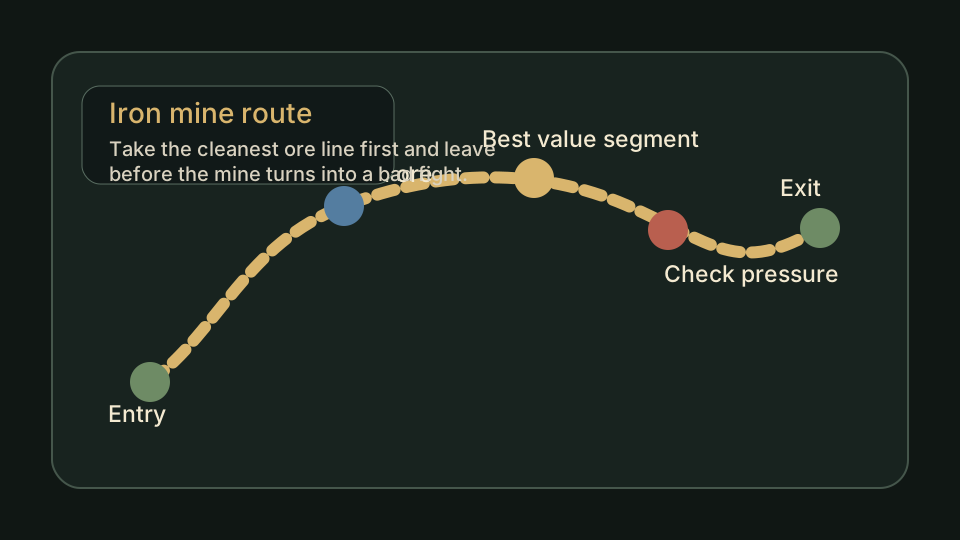
Iron mine route
Use this when the run is about ore value, pressure, and whether the return is still worth it.
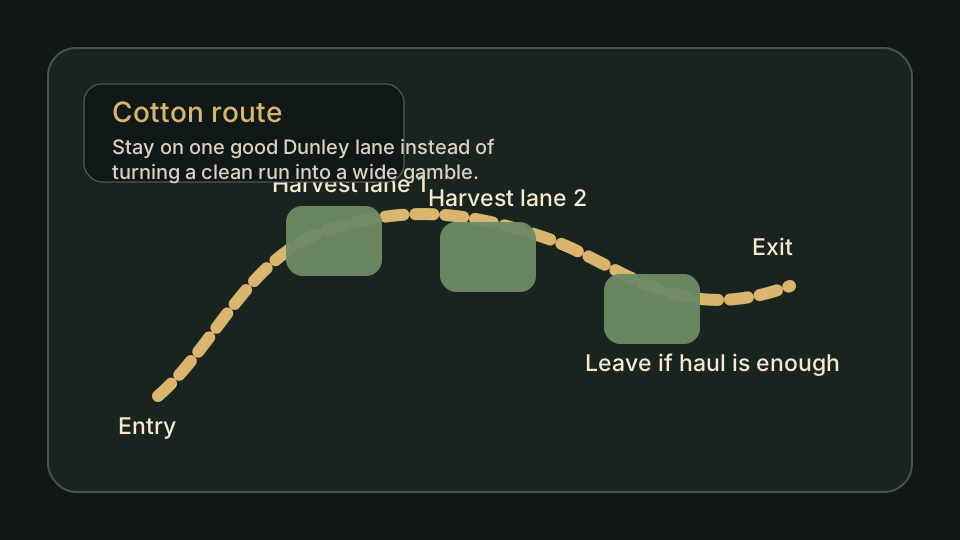
Cotton farm route
Useful when the problem is not distance, but choosing one cleaner lane to commit to.
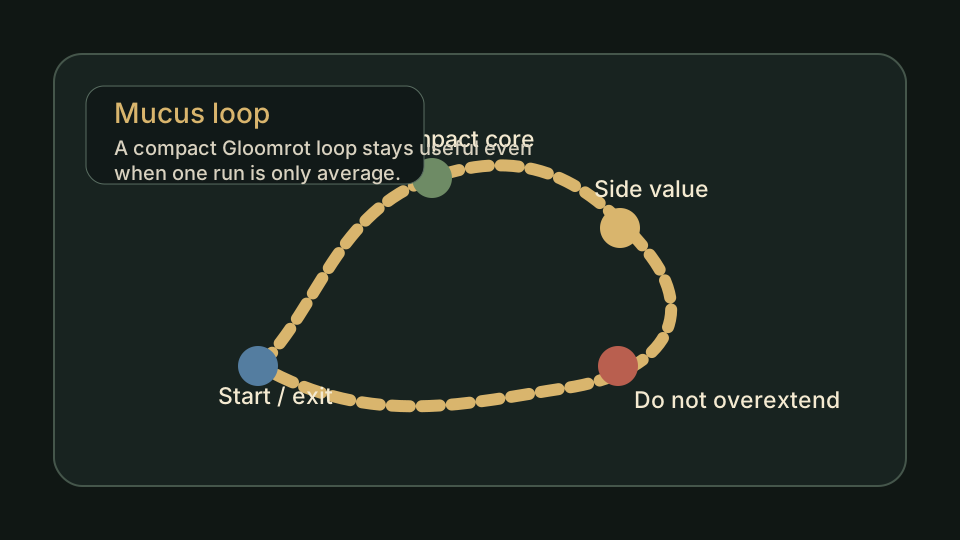
Mucus Gloomrot loop
Shows why the best route is often the one that keeps the loop compact enough to repeat.
Resource Hubs Should Choose a Route Size and Bank Point
A resource hub becomes a navigation page when it only lists materials. It should help the player choose trip size, route risk, exit timing, and what the haul should become after it gets home.
Route size
The first decision is whether the player needs a short bankable loop, a focused route, or a larger trip with a planned exit.
Payoff after home
A material route is valuable only when it feeds a craft, station, servant setup, fuel buffer, or progression step.
Failure diagnosis
If the run fails, the hub should help name whether approach, greed, inventory, return path, or castle conversion caused it.
| Hub risk | Decision this page must make | Leave for |
|---|---|---|
| The page is just a material directory | Which material route should be attempted first and how big it should be. | Matching resource guide. |
| The route succeeds but progress does not | What the haul should unlock after banking. | Crafting, Workstations, or Castle. |
| Two routes sound equally good | Which one has safer return timing and clearer payoff today. | Route Risk Comparator. |
| The player keeps dying after collecting value | Where the exit or bank point should happen. | Route Exit Checker or Run Recovery Planner. |
How to Use This Farming Hub Before You Leave Base
Read these notes as a small filter for V Rising Resource Farming Route Hub: they should turn the current uncertainty into one usable next action, not a longer tab pile.
Name the craft before the route
A farming route is much easier to judge when the player already knows what the haul should buy. If the material does not unlock, repair, craft, fuel, or improve something soon, the better first click may be Progression rather than another farming page.
Use exit cost as the real difficulty check
Most bad farming runs fail after the useful pickup has already happened. If the walk home, durability pressure, daylight, or enemy overlap is becoming more expensive than one more node is worth, the route should end.
Separate route proof from route inspiration
Official media and diagrams can make a resource page easier to understand, but the live proof still has to show a specific route claim. Until a guide has its own connected screenshot, this hub should stay honest about planned proof.
Choose between safe-first and greedy routes deliberately
A safe-first route banks a smaller haul and keeps the next session stable. A greedy route is only better when the player can handle the return, repair cost, daylight timing, and enemy overlap without turning one extra pickup into a full reset.
Track what happens after the haul gets home
A resource route is not finished when the inventory is full. The good outcome is when the haul becomes a craft, station, servant step, Castle Heart buffer, or better next route. If it sits unused, the real problem may be progression planning.
Use one failed run as diagnostic data
If a farming run fails, name where it failed: approach, first pull, inventory greed, daylight, exit path, or base return. That diagnosis points to a more useful next page than repeating the same route with no adjustment.
Which Path Should You Open First?
Use this table when V Rising Resource Farming Route Hub creates more than one plausible handoff. Pick the row that matches what actually failed in the save, then leave for that next action.
| Current problem | Open first | Why |
|---|---|---|
| You know the material but not the route | Open the matching resource guide | The material page should define route shape, risk, and leave-now timing. |
| You keep dying with useful materials | Shrink the loop | A smaller banked haul is better than a perfect-looking run that never gets home. |
| The haul does not unlock anything | Check Progression | The resource may not be the real blocker if it has no immediate craft or station target. |
| The haul gets home but sits in storage | Check Castle | Storage, refining, and station placement may be wasting the successful run. |
| The material is early but the camp is still dangerous | Use a safe-first route | Early farming should bank repeatable value before trying to full-clear a camp or mine. |
| The material is midgame and the return is expensive | Plan the exit before the first pickup | Iron, Cotton, and Gloomrot-style runs often fail because the return path was treated as an afterthought. |
| The route is easy but the payoff is unclear | Name the next craft | A low-risk route can still waste time if the haul does not buy a station, gear step, fuel buffer, or servant plan. |
| The guide has only planned proof | Use it as route guidance, not final proof | The page can help with decisions, but exact route trust improves once its own screenshots are connected. |
What This Page Should Leave to the Focused Guide
This page should help when the player knows they need materials but still needs a safer farming loop and a reason to bank the haul. It can compare player situations, tradeoffs, and handoffs, but it should not pretend to verify every connected claim by itself.
Use V Rising Resource Farming Route Hub until the next action is clear enough to leave for a named farming route, trip size, exit rule, or home-side craft. The linked guide or tool should carry the practical details once that handoff is obvious.
Planned screenshots, official reference media, and editorial diagrams should stay labeled as context until a site-owned gameplay capture proves the exact claim being discussed.