V Rising Beginner Route Hub
Reviewed on August 9, 2026. Use this page when a new save needs a route, not another isolated article. The goal is to help beginners move from first base, early unlocks, first useful boss routes, resource pressure, and travel rules into one cleaner reading path.
Use this when
Use this page when the first hours need a compact route that turns early bossing, farming, and base work into one playable loop.
Quick answer
Start with the in-game friction, then use the cards and decision rows to choose one specific guide, tool result, data row, patch check, or correction path.
Stop when
Stop here once the next action is specific enough to do in play: one specific guide, tool result, data row, patch check, or correction path.
Start With the First Save Problem You Actually Have
Beginner searches usually fail when they try to answer every system at once. Pick the card that matches the current bottleneck, then move to the linked guide.
Start with the beginner guide
Use this first when the save still needs a simple route from first base, early gear, first boss value, and safe return habits.
Choose the next boss by unlock value
Open this when the question is not where the boss is, but whether the reward actually clears the next blocker.
Use Clive as the first route test
Clive is the clearest early example of turning a boss search into route setup, nearby resource value, and exit discipline.
Turn the quarry trip into material value
Use this when the boss route is already near Sulphur and the player needs a smaller profitable loop instead of a full clear.
Fix the first base before it slows every run
A beginner route gets much easier when the first base shortens return, storage, refining, and crafting friction.
Separate teleport trips from haul-home trips
Use this before assuming every long trip can be solved by a Waygate, especially when inventory restrictions matter.
Stabilize the first material loop
Use this when the beginner problem is not a boss yet, but turning early Copper and workstation needs into a repeatable route.
Fix the first workstation confusion
Use this when Leather or the Tannery path is blocking early gear momentum and the player needs the unlock explained plainly.
Step back if everything still feels important
Use Start Here when even the beginner path feels too wide and the visitor needs to name one blocker before choosing a guide.
Early-game diagrams that make the next step easier to picture
These early-game visuals are context only. They help the hub feel closer to the real game while staying separate from site-tested proof.
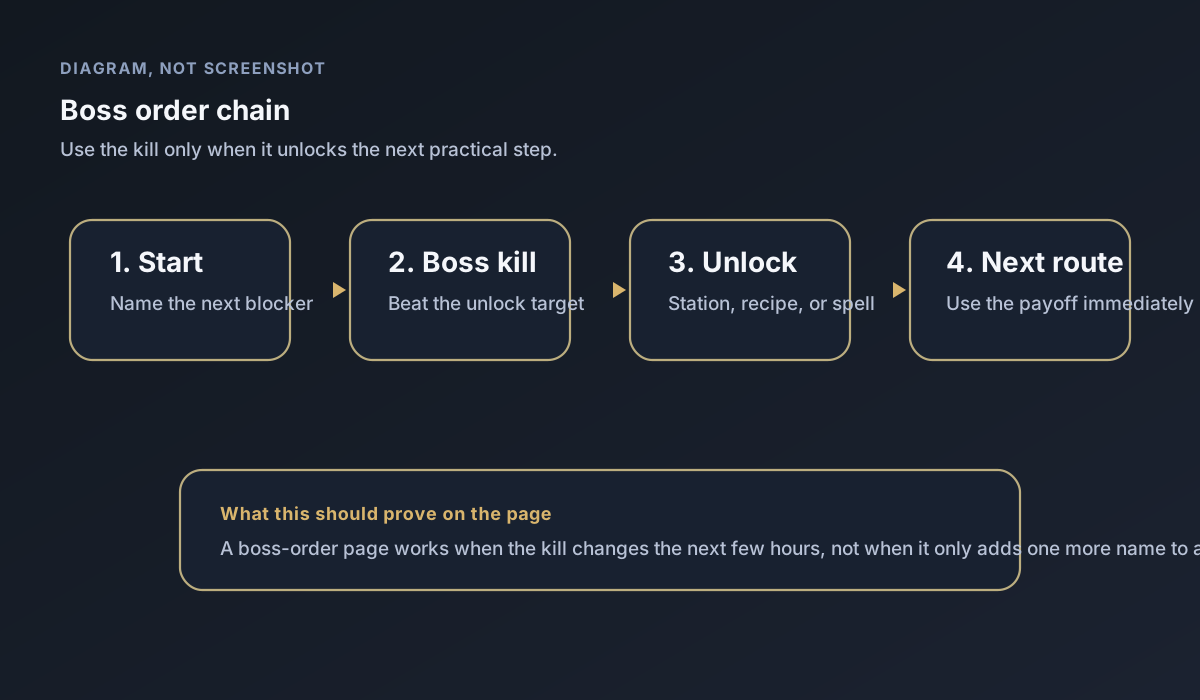
Boss order chain
Use this when the real question is unlock value, not which boss sounds strongest on paper.
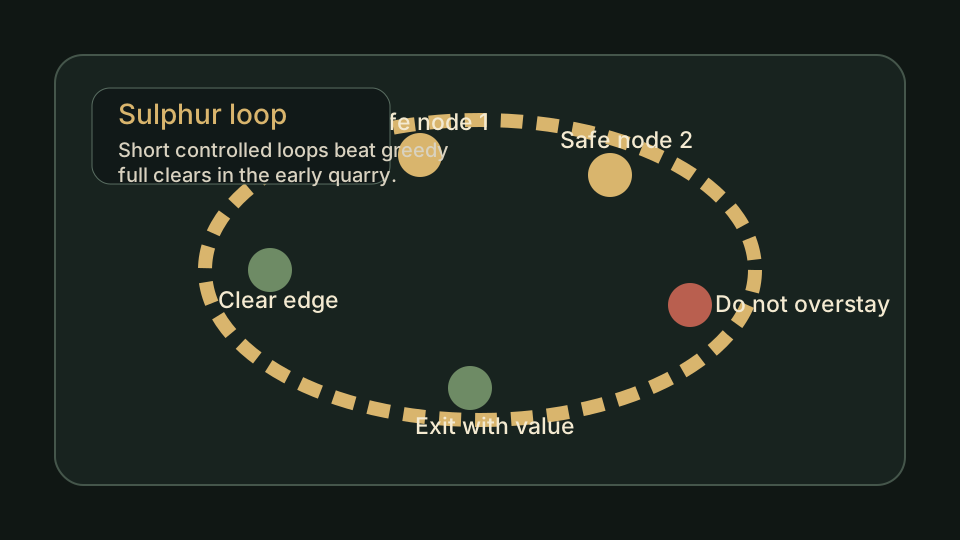
Sulphur quarry loop
A compact route sketch for the first quarry decisions that matter most.
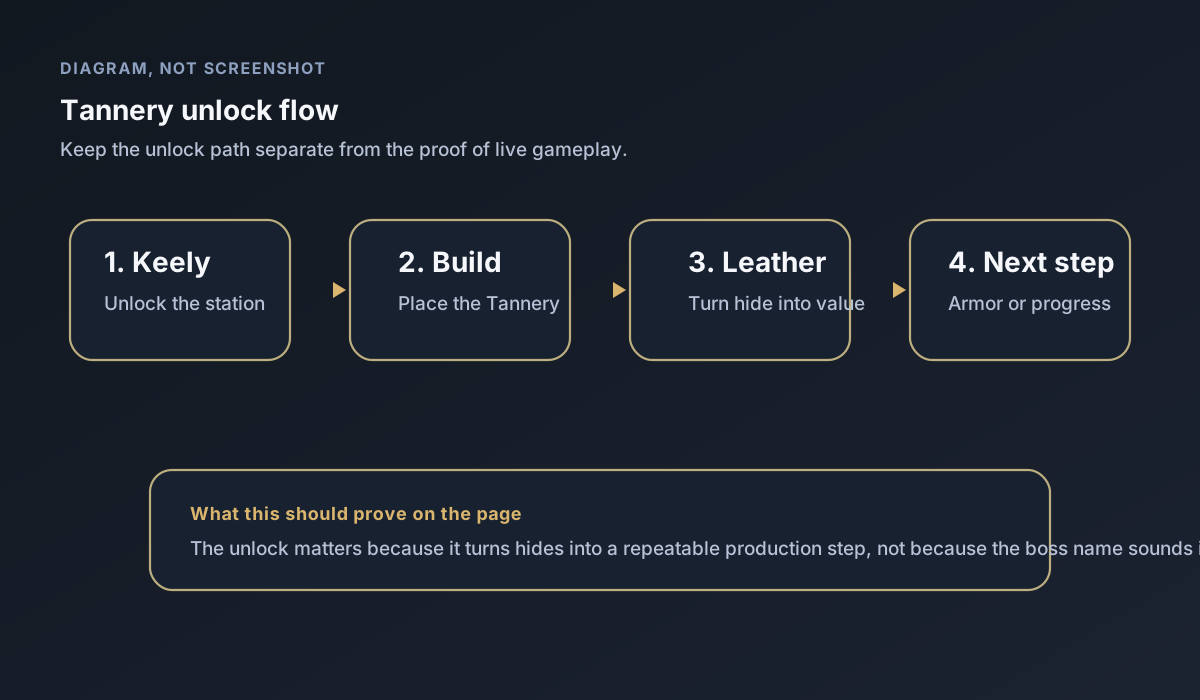
Tannery unlock flow
Useful when the save needs one clearer path from boss kill to real crafting progress.
Beginner Hubs Should Produce One First Play Block
A beginner hub risks becoming a menu when it exposes every system at once. It should reduce the first hour to one base choice, one unlock, one material loop, or one route test that makes the next session clearer.
First blocker
The hub should identify whether the new save is blocked by boss order, first base, early materials, travel rules, or workstation confusion.
Good enough first
Beginners do not need perfect routes. They need one safe action that banks value and teaches what the next guide should be.
Stop reading
Once the player has one next action, the hub should send them to that page and stop acting like a complete walkthrough.
| Hub risk | Decision this page must make | Leave for |
|---|---|---|
| The page exposes too many beginner systems | Which single blocker matters in the next play block. | Beginner Guide or Start Here. |
| The player knows a boss name but not the reason | Whether the kill unlocks something useful now. | Boss Order or Clive guide. |
| The first farm route keeps failing | Whether the loop is too wide, too risky, or not tied to a craft. | Resource Farming Route or Run Prep Checklist. |
| The base slows every return | Whether location or layout should be fixed before wider progression. | Castle Planning. |
How to Use This Beginner Hub Without Over-reading
Read these notes as a small filter for V Rising Beginner Route Hub: they should turn the current uncertainty into one usable next action, not a longer tab pile.
Start with one session goal
A beginner route gets worse when every system sounds equally urgent. Pick one goal for the next session: place a usable base, unlock one practical station, kill one boss for a named reward, or bring home one material that buys a clear upgrade.
Move sideways when the guide stops matching your save
If a boss guide feels too hard, do not force the boss just because the route says it is next. Move sideways into resources, base flow, or travel planning until the original guide starts matching the save again.
Treat broad advice as routing, not proof
This hub helps choose pages; it does not prove a route by itself. When a linked page lists proof slots, that page still decides which screenshot or live test would be needed before the claim becomes site-tested proof.
Do the first useful thing before the perfect thing
New saves often stall because the player hunts for the perfect base spot, perfect boss order, or perfect farm route too early. The better first move is usually the good-enough action that makes the next session safer and clearer.
Use failed attempts to choose the next guide
If the first boss attempt fails, the answer may be prep, route pressure, or gear. If the first farm route fails, the answer may be exit timing. If the return home feels bad, the answer may be castle flow. A failed attempt should point to the next page.
Stop reading once the next action is clear
A beginner hub should not trap visitors in endless research. Once the player knows the next boss, material, workstation, or castle fix, the best move is to open that specific guide and then play a short test session.
Which Path Should You Open First?
Use this table when V Rising Beginner Route Hub creates more than one plausible handoff. Pick the row that matches what actually failed in the save, then leave for that next action.
| Current problem | Open first | Why |
|---|---|---|
| You do not know what to do next | Open Beginner Guide first | It gives the broadest first route without pretending every system needs mastery now. |
| You know the boss name but not the payoff | Open Boss Order | The boss should be chosen by what it unlocks for the save, not only by list order. |
| The first route keeps getting messy | Open Clive or Sulphur | Those pages show route discipline: one job, one payoff, and a clear exit. |
| Returning home feels slow | Open Castle pages | The route may be fine while the base loop is wasting the value after each run. |
| The first hour feels busy but not productive | Pick one session goal | The save improves faster when the player chooses one base, one unlock, or one material target instead of touching every system. |
| A boss is technically available but the route feels awful | Move sideways into resources or base flow | A boss that is next on paper may still be wrong if gear, healing, or return routes are not ready. |
| You are carrying useful loot but do not know what it buys | Open Progression or a workstation page | Beginners need a reason for each haul, not a storage chest full of future maybes. |
| You keep expanding the castle before the basics work | Open Base Location or Efficient Layout | Early castle work should protect short loops before the base becomes decorative. |
What This Page Should Leave to the Focused Guide
This page should help when the first hours need a compact route that turns early bossing, farming, and base work into one playable loop. It can compare player situations, tradeoffs, and handoffs, but it should not pretend to verify every connected claim by itself.
Use V Rising Beginner Route Hub until the next action is clear enough to leave for one specific guide, tool result, data row, patch check, or correction path. The linked guide or tool should carry the practical details once that handoff is obvious.
Planned screenshots, official reference media, and editorial diagrams should stay labeled as context until a site-owned gameplay capture proves the exact claim being discussed.