V Rising Boss Database
Reviewed on August 17, 2026. Use this lane when the next real question is which boss should matter now, what unlock the fight solves, and whether the route or pull needs prep before the fight becomes worth taking.
15 boss-side entries
This lane currently groups direct boss rows, combat-prep rows, and Boss Chain rows so the fight and the setup around it can be filtered together.
Best use case
Start here when the save needs an unlock, not just any activity. Boss rows help narrow the next kill by value instead of level alone.
What this lane separates well
It distinguishes the boss choice itself from the pull setup, safe approach, or camp pressure that often causes the real failure.
Open boss rows
Jump straight into the full database already filtered to boss entries.
Three clean ways to start inside the boss lane
These shortcuts reduce the chance of opening the wrong page first. Each one starts from a different boss-shaped problem.
Early boss choices
Best when the next unlock matters more than squeezing one more generic farm run out of the save.
Boss pull prep
Best when the real blocker is not the boss name but messy camp pressure, adds, or a bad first pull.
Boss pages waiting for proof
Best when the question is whether the page already has enough visible evidence to trust quickly.
| If the problem is... | Open first | Why |
|---|---|---|
| which unlock should matter next | Boss rows | These rows keep unlock value and stage fit in view before you over-focus on boss level alone. |
| the route reaches the camp but the pull falls apart | Combat Prep rows | The page you need may be the prep note, not another broad fight overview. |
| you know the boss but not whether the run is worth it yet | Boss Order Planner | The planner is better when the real question is “should this be next?” rather than “where is this boss?” |
| the page feels useful but still low-trust | Visual Coverage | Proof status tells you whether the guide still depends mostly on editorial routing and pending screenshots. |
What the boss lane is good at, weak at, and best paired with
This lane should do more than restate boss names. Its job is to help a player decide whether they need ranking, prep, proof confidence, or the full guide before taking another boss attempt.
Strongest right now
The lane is strongest when the save needs a meaningful unlock and the player is still weighing value. It keeps unlock importance, stage fit, and setup pressure visible together instead of hiding them inside one long boss page.
Weakest right now
It is weaker when the player already chose the boss and only needs local fight execution. If the real issue is add pressure, arena clutter, or timing on one pull, the linked guide should take over quickly.
Best paired pages
The best companion surfaces are the Boss Order Planner for ranking, the proof board for trust, and the individual boss guide for execution detail. That combination makes the lane feel maintained and reusable instead of generic.
Eight boss-chain rows now feed the database layer
These rows make boss decisions reusable. They connect unlock value, route prep, proof priority, and patch-sensitive rechecks into the same database layer used by the filters.
| Database row | First decision | Why this is useful now |
|---|---|---|
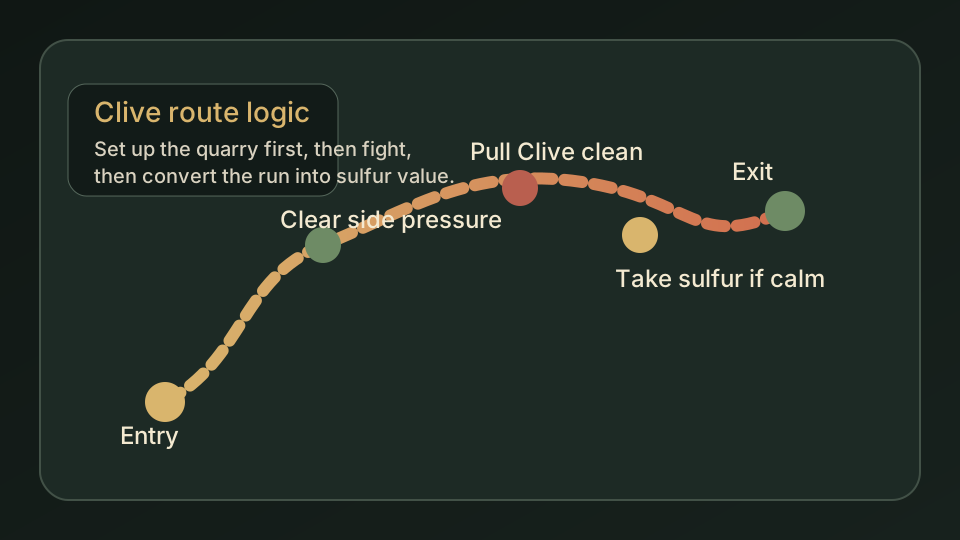
| Clive quarry unlock chain | Boss kill, Sulphur run, or combined quarry attempt | Connects Clive to explosives and quarry route value before the run gets too wide. |
| Grayson Whetstone chain | Emergency Whetstone route or steadier Grayson unlock path | Helps players move from short-term loot pressure into progression value. |
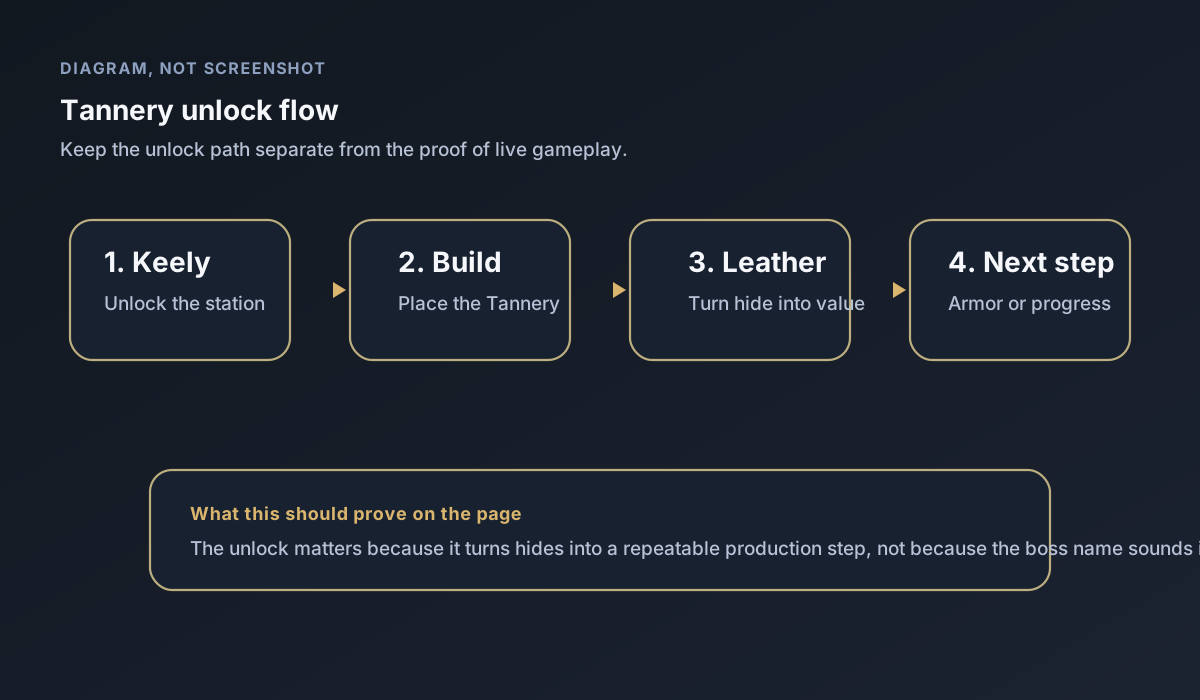
| Keely Tannery chain | Keely route, Leather production, or Tannery placement | Turns a boss target into a real early production loop. |
| Rufus production chain | Rufus now or another material route first | Frames Rufus by production value instead of only boss availability. |
| Boss pull prep chain | Right boss, wrong pull setup, or messy approach lane | Separates boss choice from the camp pressure that often causes the real wipe. |
| Unlock value comparison chain | Which available boss reward fixes the current save fastest | Lets the database support boss ranking without forcing a full boss-order page first. |
| Boss proof-priority chain | Which boss route screenshot should be captured first | Connects boss-page trust work to the public proof queue. |
| Patch-sensitive boss recheck chain | Trust old boss advice or recheck route/reward after changes | Keeps boss guidance honest when version or server context may have shifted. |
Boss guides
Leave the database lane and open the full guide once the right boss target is obvious.
Boss Order Planner
Use the planner when several bosses sound plausible and the route value still needs ranking.
Boss proof queue
Check the testing queue when you want to know which boss pages still need live route proof first.
Patch-sensitive checks
Open Updates if a patch may have changed a boss area, reward, or route confidence.
This lane helps choose fights; it does not fake fight proof
The boss lane is a routing layer inside the database. It is useful because it groups unlock logic, route value, and prep notes together, but it still depends on the linked guide for page-level nuance, proof status, patch caution, and correction flow.
Use this lane to decide which fight deserves attention. Once the right fight is named, the better next click is usually the guide itself, the boss planner, or the proof board—not more broad browsing.
Boss Rows Should Explain Unlock Payoff, Not Just Names
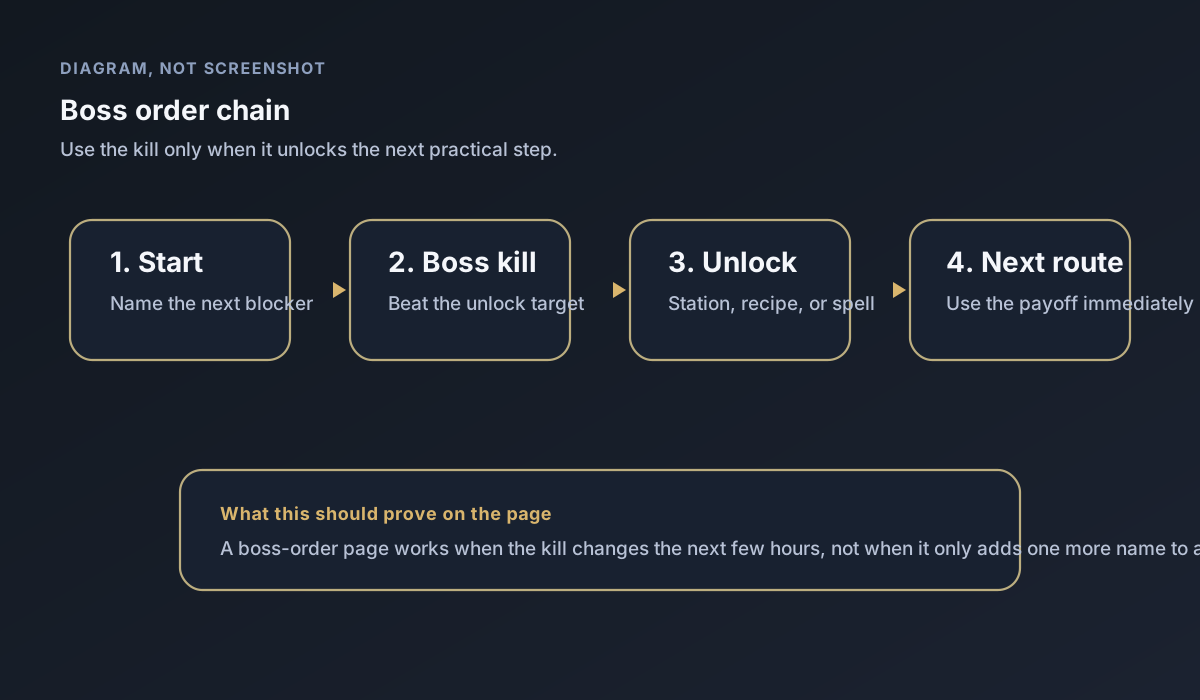
A boss database lane risks becoming a doorway page if it only repeats boss labels and guide links. Its value is the row-level decision: what the kill unlocks, what route pressure it creates, and when another system should be checked first.
Unlock payoff
Each boss row should help the reader ask what changes after the kill: a station, recipe, spell, travel option, servant step, or cleaner progression chain.
Route pressure
A boss name is not enough. The lane should expose whether the approach, nearby enemies, return trip, or prep burden is likely to be the real blocker.
Proof boundary
The database can route players before proof is complete, but live location, arena, and approach confidence still belong to the linked guide and proof status.
| Database row situation | Field to judge | Leave for |
|---|---|---|
| You know the boss but not why it matters | Unlock value, stage, and next useful system. | Boss Order, Progression, or Boss Unlock Payoff Checker. |
| The boss is known but the approach keeps failing | Region, route risk, prep need, and linked route guide. | Boss guide, Run Prep Checklist, or Route Database. |
| Two bosses both look plausible | Which kill changes the save sooner and with less route waste. | Boss Order Planner. |
| A patch may have changed the encounter | Review date, proof status, and update sensitivity. | Updates, Review Queue, or the linked boss guide. |